

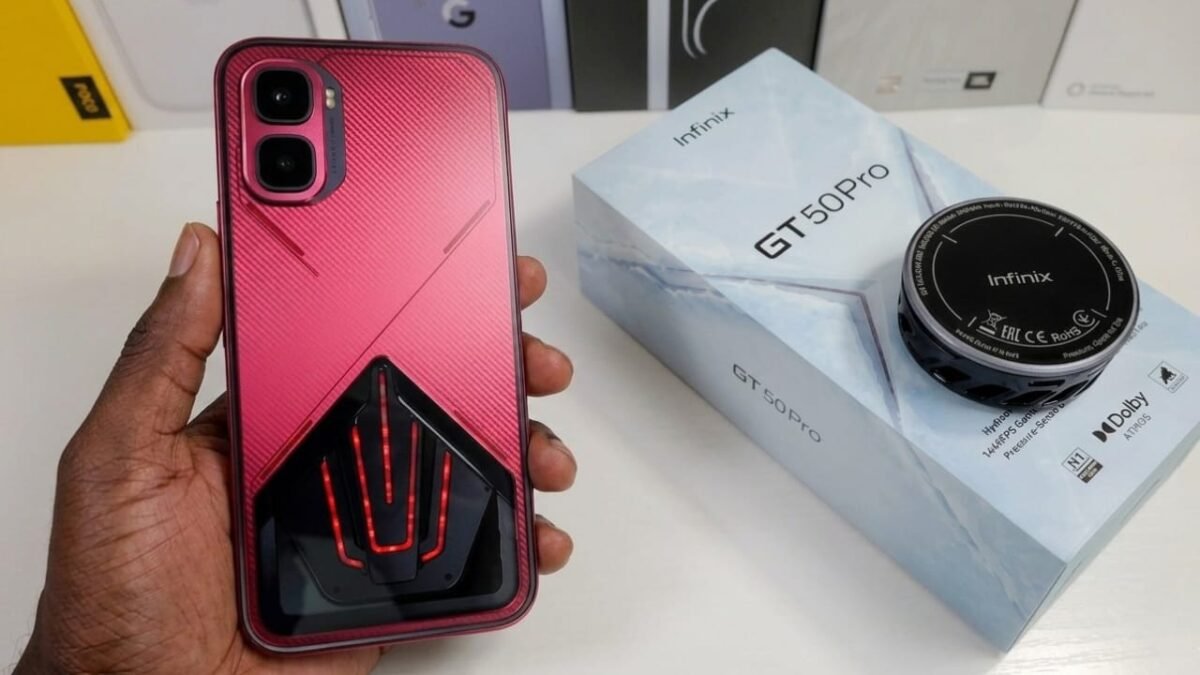
Infinix has confirmed that the GT 50 Pro arrives in Nigeria this September, which makes it the second African market to get the phone after Kenya took it in August. If you play mobile games seriously and you’ve been watching this one since the global launch in April, your wait is nearly over.
What you’re getting is a Dimensity 8400 Ultimate, a 144Hz AMOLED, two physical shoulder triggers and an actual liquid cooling pump moving coolant around inside the phone. Eighteen months ago that combination would have cost you flagship money. Kenya’s official launch price came in at KES 59,999, which works out around $465, and that gives you a reasonable idea of the neighbourhood even though Infinix has not yet said what Nigerians will pay.
Where the GT 50 Pro has actually landed in Africa
| Market | Status | Confirmed price |
|---|---|---|
| Global launch | Announced 17 April, launched 24 April 2026 | Varies by market |
| Kenya | Launched August 2026 | KES 59,999 (12GB / 256GB) |
| Nigeria | Launching September 2026 | Not yet announced |
| Ghana | Rollout not confirmed | Not announced |
| South Africa | Rollout not confirmed | Not announced |
| Egypt | Appearing at local retailers | No official price published |
In Kenya the phone sells through official Infinix stores, Safaricom shops and third-party retailers including Phone Place Kenya, with a one-year warranty. Infinix ran a launch promotion from 13 to 22 August that bundled 50 percent off the GT accessory range covering the GT Buds, GT Power Pod and GT Watch 5 Pro, plus 180 days of screen replacement cover. It’s worth watching for something similar around the Nigerian launch, since Infinix tends to repeat this pattern market by market.
About those naira prices you’re seeing online
If you search for the Infinix GT 50 pro’s Nigerian price right now and you’ll find figures of ₦528,000, ₦850,000 and ₦925,700, all presented as fact on different sites. They cannot all be right, and in fact none of them are because Infinix has not published a Nigerian price yet as of this particular time I’m writing this.
So, You should wait for the official announcement and treat any figure quoted before then as guesswork. If a seller whether online or anywhere in Nigeria quotes you a price before the Official launch by Infinix themselves, they’re probably pricing imported stock rather than the Nigerian retail unit, and the two things carry different warranties.
Check which battery you’re actually buying
This is the detail that matters most and it barely appears in launch coverage. The GT 50 Pro ships in two battery configurations depending on market, one at 5,200mAh and one at 6,500mAh. Kenya received the 6,500mAh version.
That’s a 25 percent difference in capacity on a phone whose whole pitch is lasting through long gaming sessions, and you will not see it on the front of the box. There are also two storage options, 12GB with 256GB and 12GB with 512GB, and which of those reaches Nigeria has not been confirmed either. Ask the retailer which configuration they’re selling and check it on the device itself under Settings > About phone before you pay. This goes double for imported stock, where the unit in front of you may have been built for an entirely different market.
A phone that has clearly decided what it is
You won’t mistake this for anything else on a Nigerian phones shelf. The back panel layers a kevlar-style texture with mechanical lines and a transparent window Infinix calls the Pipeline Window, which lets you actually watch the coolant moving through the cooling system. There are RGB strips running through the panel that respond to notifications, charging, incoming calls and in-game events. You can switch all of it off, and you can also leave every trigger enabled and watch your battery pay for the privilege.
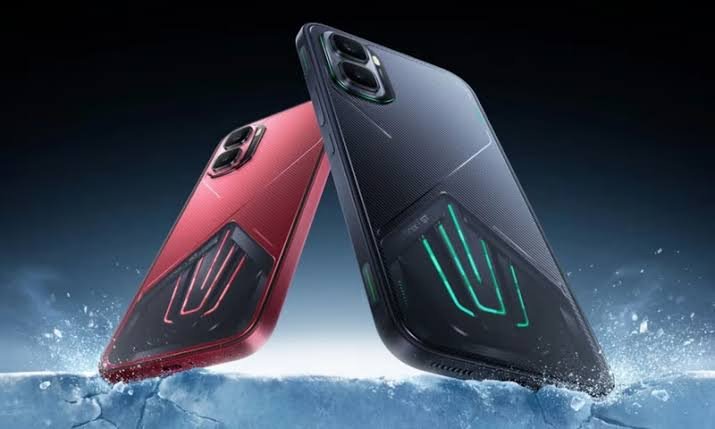
More impressive than the styling is that Infinix kept this to 198g at 8.2mm thick while fitting a liquid cooling pump and a battery that size inside. The frame and back are plastic with Gorilla Glass 7i over the front, and the whole thing is IP64 rated, so it handles dust and splashes but is not something to take near water. Three colours are available, Black Abyss, Red Blaze and Silver Glacier.
The display and the chip do their jobs
The screen is a 6.78-inch AMOLED at 1208 by 2644, which is noticeably sharper than the Full HD panels most phones near this price still use. It runs 144Hz with 330Hz touch sampling and 10-bit colour, and peak brightness is quoted at 4,500 nits. That touch sampling figure is the one to care about if you play competitively, because it governs how fast the screen registers your input rather than how smoothly things animate. On brightness, treat 4,500 nits as a peak on a small part of the panel rather than something you’ll see across the whole screen, though it does handle Nigerian afternoon sun better than most phones at this money.
The Dimensity 8400 Ultimate uses an all big-core CPU design on a 4nm process running up to 3.25GHz, with a Mali-G720 MC6 GPU, 12GB of LPDDR5X and UFS 4.1 storage. That storage standard is what makes big games load quickly and it’s frequently the corner cut on phones that look similar on paper. Reviewers have recorded AnTuTu v11 scores reaching around 2.2 million.
The genuinely unusual part is the cooling. Infinix calls it Micro-Pump HydroFlow and it uses a piezoelectric ceramic micro-pump to move real coolant through channels inside the phone rather than relying on a passive vapour chamber. GSMArena’s stress testing found sustained performance held up well, which is the entire point, because almost any modern chip can sprint for ten minutes before the frame rate starts sliding. In Nigerian and Kenyan ambient temperatures that matters more than it does in a European review lab.
The triggers are the reason to pick this over a normal phone
Two pressure-sensitive shoulder triggers sit along the top edge, each with ten sensitivity levels and four mappings. If you play shooters, this changes how the phone feels in a way no amount of raw processing power does, because it takes your aiming and firing off the same screen your thumbs are already crowding.
Infinix pairs this with what it markets as a 144FPS gaming ecosystem across a supported title list it puts at over 28 games. Be clear about what that means though, because a 144Hz display cannot make a game run at 144 frames if the game itself caps at 60 or 90. The benefit is real but it only applies to titles built for it, so check whether the games you actually play are on the list rather than assuming everything gets faster.
There’s also an optional MagCharge Cooler 2.0 that clips magnetically to the back, adding 15W wireless charging alongside 12W of thermoelectric cooling. You need it if you want bypass charging, which feeds power straight to the board while you play instead of running it through the battery. Whether it’s worth buying depends on how long your sessions actually run.
Battery and charging
Assuming you get the 6,500mAh configuration, GSMArena’s testing put active use at around 15 hours, which will see you through a heavy day comfortably. Charging runs at 45W wired with the adapter in the box, 30W wireless, and 5W reverse wireless if you want to top up earbuds. Fisayo Fosudo’s testing put a full charge from empty at roughly one hour and twelve minutes, which is respectable rather than remarkable, and slower than rivals pushing higher wattage at the cost of long-term battery health.
Cameras are not why you’re here
You get a 50MP main sensor at f/1.8 with optical stabilisation and phase detection autofocus, an 8MP ultrawide covering 111 degrees, and a 13MP front camera, with 4K recording front and back. The main sensor with OIS gives you good daylight shots and acceptable low-light results, which is about where a gaming phone at this price should land. The ultrawide is the weaker of the two and the drop in detail is obvious when you switch to it.
If photography sits near the top of your list, the same money spent on something from the Note range will serve you better, and that’s a reasonable trade rather than a failing of this phone.
The one thing that genuinely disappoints
The stereo speakers carry Dolby Atmos branding and 24-bit Hi-Res certification, and they get loud. The problem shows at the top of the volume range, where the sound thins out and loses its low end, with audible distortion at maximum. TalkAndroid checked whether they’d received a faulty unit and found other reviewers describing exactly the same thing, so this is how the phone is rather than bad luck.
On a phone built around immersion that’s a real miss. At normal listening levels it’s fine, and any decent pair of wireless earbuds sidesteps it completely, but you should know before you buy rather than after.
Software, connectivity and support
It ships on Android 16 with XOS 16 over the top, and Infinix commits to three major Android upgrades plus five years of security patches, which should keep the phone current into 2029. XOS still arrives with a fair amount of preinstalled software, so give yourself twenty minutes with Settings > Apps after setup to clear out what you don’t want.
You get 5G, NFC, dual nano-SIM and eSIM support, though activating the eSIM automatically disables the second physical SIM slot, which is worth knowing if you run two lines. There’s an under-display optical fingerprint reader and Infinix’s N1 chip for network stability. No 3.5mm headphone jack.
One thing to confirm at purchase is 5G band support against your operator. African 5G deployments run largely on band n78, and if you’re buying imported stock rather than the Nigerian retail unit, check that band appears in the supported list before paying a premium you can’t use.
Should you buy it
If you play mobile games seriously and dedicated gaming phones have been out of reach, this is the most interesting option available to you right now. The triggers and the active cooling are things you simply cannot get by buying a faster mid-range phone instead, and at Kenya’s pricing the combination is unusual.
If you game casually you’re paying for hardware you won’t use, and the same money buys a better camera and quieter styling elsewhere in the Infinix range. And if you listen to a lot of audio through the phone’s own speakers, take the distortion seriously.
For Nigerian buyers specifically, hold on until the official launch and the official price. Confirm the battery configuration, confirm the storage variant and confirm the warranty is a Nigerian one before you hand over money. On a phone sold on endurance, the difference between 5,200mAh and 6,500mAh is the difference between the device you read about and a lesser version wearing the same name.
This assessment draws on published specifications, testing reported by independent reviewers including GSMArena and Fisayo Fosudo, and pricing confirmed by official launches in African markets. GadgetNaire has not had a review unit of this device. Prices and availability were accurate at the time of writing and should be confirmed with the retailer.

Join the conversation