

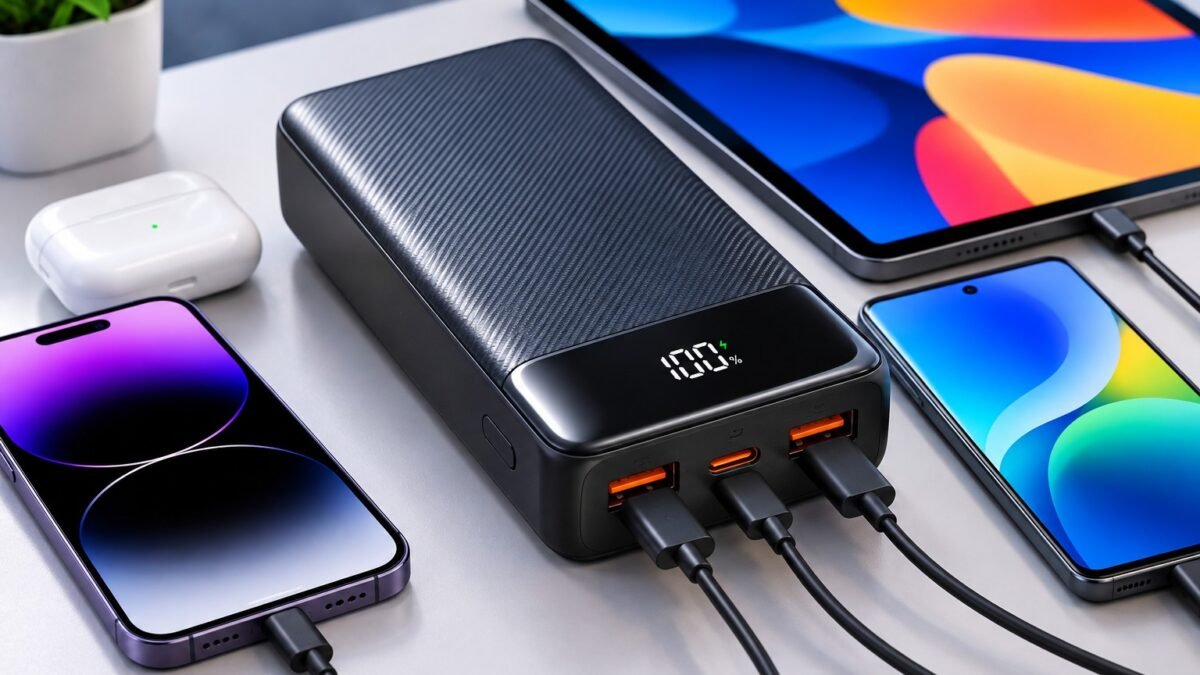
You can take a power bank on a plane without anyone’s approval as long as it’s rated at 100Wh or less, and most 30,000mAh models sold in Nigeria come out at about 111Wh, which puts them over that line. Airlines have been allowed to approve power banks between 100Wh and 160Wh, but IATA has told airlines that this allowance won’t carry into the edition of its Dangerous Goods Regulations that takes effect on 1 January 2027.
That matters here more than in most places, because big power banks are a normal purchase in Nigeria. When the light is unreliable, a 30,000mAh or 40,000mAh unit that can recharge a phone several times makes a lot of sense at home. The good news is that you don’t need to give up on backup power to travel. You just need to know how to read the label before you pay, and the checks below will help you choose one that works for both the house and the airport.
| 10,000mAh | About 37Wh, within the 100Wh limit |
|---|---|
| 20,000mAh | About 74Wh, within the 100Wh limit |
| 26,800mAh | About 99Wh, right at the limit |
| 30,000mAh | About 111Wh, over 100Wh |
| 40,000mAh | About 148Wh, over 100Wh |
| 50,000mAh | About 185Wh, over 160Wh |
Why mAh doesn’t tell you if a power bank can fly
Sellers in Nigeria almost always advertise power banks by mAh, but aviation rules are written in watt-hours (Wh), which measure the actual energy stored. To convert, multiply the mAh figure by the battery’s rated voltage and divide by 1,000. Most power banks use lithium cells rated at 3.6V or 3.7V, so a 20,000mAh unit lands at roughly 72Wh to 74Wh, while a 30,000mAh unit lands at roughly 108Wh to 111Wh.
The safer habit is to look for the Wh figure printed on the power bank itself, usually in the small text near the ports or on the underside. IATA’s travel guidance on lithium batteries tells passengers to “always check your battery’s watt-hour rating (printed on the device or battery label) and confirm with your airline”. If a power bank has no rating on it at all, don’t buy it for travel, because a security officer has no way to confirm what it holds and can simply refuse it.
The power bank on a plane rules that changed in 2026
The International Civil Aviation Organization tightened the rules from 27 March 2026. In its announcement of the new restrictions, ICAO said power banks “will now be limited to two per passenger, and passengers will be prohibited from recharging them during flights”. Nigeria is one of ICAO’s 193 member states, so these standards shape what airlines flying in and out of the country apply.
IATA’s guidance to airlines on power banks fills in the rest. Power banks must travel in your hand luggage, never in checked bags, and each one has to be protected from short circuits when you’re not using it. IATA also recommends that you don’t use a power bank to charge your phone or laptop while on board, although that part is a recommendation rather than a hard rule.
Why 30,000mAh and 40,000mAh buyers should think twice before January
Right now, a power bank between 100Wh and 160Wh can still fly if your airline approves it, and that’s the category most 30,000mAh and 40,000mAh units fall into. IATA’s guidance says this allowance won’t be carried into the 68th edition of its Dangerous Goods Regulations, citing concerns about regulatory oversight of power bank manufacturers. That edition comes into force on 1 January 2027, and the passenger table in the same guidance lists power banks above 100Wh as forbidden.
How strictly this is applied depends on each country’s regulator and each airline, and IATA itself notes that some states adopt changes immediately while others take longer. So don’t assume a big power bank will be turned away on every route from January, but don’t count on an approval either. If you fly often, whether it’s Lagos to Abuja for work or Lagos to Dubai or London, buying a 40,000mAh unit now could mean leaving it at home within a few months.
How to pick one power bank that works at home and at the airport
For most people, a 20,000mAh power bank is the sweet spot. It’s usually enough for about three full charges of a phone with a 5,000mAh battery, it sits comfortably under 100Wh, and it doesn’t need anyone’s approval at the airport. If you need more backup at home during long outages, the practical answer is to keep a larger unit for the house and a 20,000mAh one for your travel bag, rather than one giant power bank that tries to do both.
Be careful with the capacity claims themselves, because a label is only useful if it’s honest. Our guide on how to tell if a power bank actually holds what it claims shows you how to spot inflated numbers before you pay, and it’s worth pairing with our checks for a phone’s real battery health if you’re buying both at once. The practical aim isn’t to buy the smallest power bank you can find. It’s to buy one with a clear Wh rating that fits the way you actually live and travel.




Join the conversation