

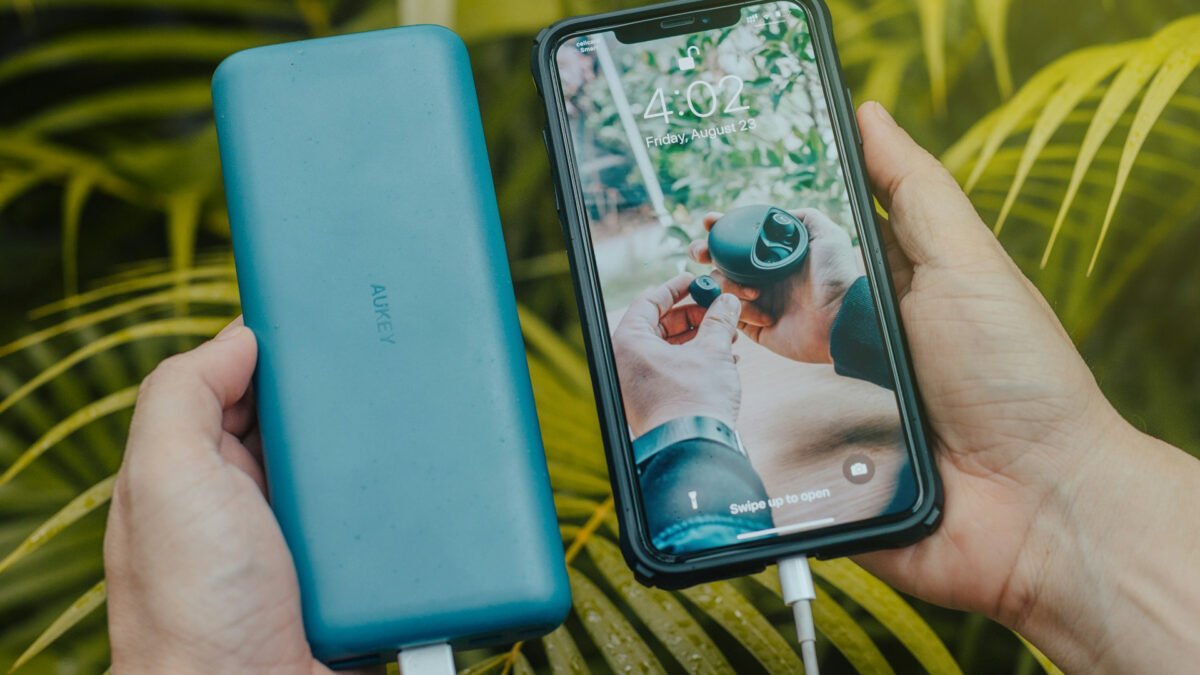
A power bank labelled 20,000mAh will deliver somewhere around 12,000mAh to your phone. That gap is not fraud and it is not a defect. It is the result of the label describing one thing while the buyer assumes it describes another, and understanding which is which is the difference between choosing well and paying for a number that was never going to reach your device.
This matters more across African markets than almost anywhere, because a power bank here is often the difference between a working phone and a dead one rather than a travel convenience. Getting the purchase right is worth a few minutes of arithmetic.
The number on the box is measured somewhere your phone never sees
The mAh figure printed on a power bank describes charge capacity at the internal cell voltage, which for lithium-ion is typically 3.7 volts. Your phone charges over USB at 5 volts or higher, so the power bank has to boost the voltage before anything reaches your device, and that conversion costs energy as heat.
The arithmetic is straightforward once you see it. A 10,000mAh unit at 3.7V holds 37 watt-hours of energy. Boosting that to 5V gives a theoretical 7,400mAh, and once circuit losses of 10 to 15 percent are taken out you land near 6,300mAh actually delivered. Scale it up and a 20,000mAh unit typically hands over between 12,000 and 13,000mAh in practice.
Anker, which publishes its own explanation of this, makes the point plainly that the losses are physics rather than marketing. The problem is that two power banks can suffer very different losses, and the label gives you no way to tell them apart.
The one figure that lets you compare honestly
Look for watt-hours rather than mAh. Wh measures actual stored energy and does not shift with voltage, which is exactly why aviation authorities use it for their limits rather than mAh.
The conversion is simple. Multiply the mAh figure by 3.7 and divide by 1,000. A genuine 10,000mAh unit is 37Wh. A genuine 20,000mAh unit is 74Wh. Now check that against what is printed on the casing, and if the two do not agree, one of the numbers is wrong. A unit claiming 20,000mAh while printing 37Wh on its label is telling you, in a place most buyers never look, that it holds half what the front of the box says.
Better manufacturers also print a rated output figure, usually written as something like 12,000mAh at 5V. That is the honest number, measured under standardised testing, and it is what you will actually receive. A power bank that publishes it is telling you something about itself before you have even used it.
A rough check you can run with your hands
Lithium cells have mass, and no amount of labelling changes that. Energy density for lithium-ion sits somewhere around 200 to 250 watt-hours per kilogram at cell level, which means the cells inside a genuine 20,000mAh power bank weigh roughly 300 to 370 grams before you add the casing, circuitry and ports.
A real 20,000mAh unit therefore lands somewhere around 350 to 450 grams in total. If one feels light enough to forget in a shirt pocket, the cells claimed on the label are not inside it. This is a rough sanity check rather than a measurement, but it catches the worst offenders in a market where counterfeit units are common, and it costs nothing to pick two up and compare them.
What actually determines whether it charges your phone fast
Capacity tells you how much. Output wattage and protocol tell you how quickly, and the two are independent, which is why a large power bank can charge slowly and a small one quickly.
Check that the unit supports USB Power Delivery over USB-C if your phone does, since PD is the standard most modern devices negotiate. Proprietary fast charging systems used by some manufacturers will fall back to slow charging on a power bank that does not implement them, and that fallback is often 5W, which is slower than the charger in the box by a wide margin.
Two practical limits are worth knowing. Charging two devices at once cuts your total available output by somewhere between 15 and 25 percent because of shared load and heat. And units without proper thermal management throttle their output after ten or fifteen minutes at higher wattages, which can reduce total delivered charge by close to a fifth across a full cycle. A metal-bodied unit that runs warm rather than hot is generally doing better here than a plastic one that gets uncomfortable to hold.
Sizing it to what you actually need
Work backwards from your phone’s battery. A device with a 5,000mAh battery needs roughly 5,000mAh delivered for a full charge, so a 10,000mAh power bank delivering around 6,300mAh gives you a single full charge with a little spare, not the two charges the label implies. A 20,000mAh unit delivering around 12,500mAh gives you two full charges and a useful margin.
Laptops are a different requirement entirely. Most need at least 45W sustained input over USB-C PD, and a power bank that lists high capacity but tops out at 18 or 20W output will not charge one meaningfully even if it has the energy to spare. Check the output wattage before the capacity if a laptop is part of the plan.
One limit to keep in mind if you fly. Airlines cap carry-on batteries at 100Wh, which works out to about 27,000mAh at cell voltage, and units above that need airline approval or will be refused at security.
Take the three numbers together and the purchase settles itself. Confirm the watt-hours agree with the mAh claim, look for a rated output figure at 5V, and check the output wattage matches what you intend to charge. A unit that gives you all three is telling you the truth about itself, and in this category that is most of what you are paying for.




1 comment
[…] If your budget is well below what the real thing costs, buy a genuine pair from a brand that builds at your price instead. You get a working warranty, a working app, firmware updates and battery cells that hold their rating. A fake gives you none of that, and the battery usually fails within months because that is where the cutting is heaviest. The same principle applies to other accessories, which is why it helps to know how to tell if a power bank actually holds what it claims. […]