

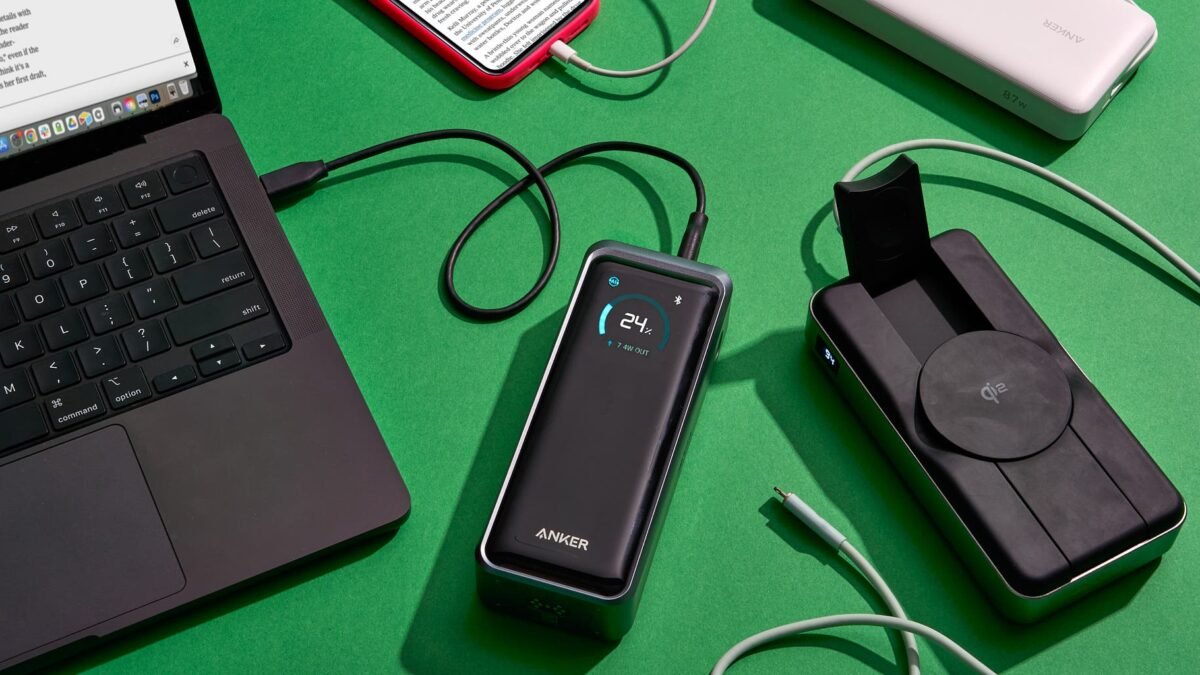
Before you buy a laptop power bank in Nigeria, check that it has a USB-C port that delivers 20V, with enough watts on that single port to match your laptop’s own charger. Most power banks sold here are built for phones and top out at 22.5W, which is fine for a Tecno or an iPhone but won’t keep a 65W laptop alive during a long power outage.
The good news is that you can work out whether a power bank will charge your laptop before you pay, using nothing more than the label on your laptop charger and the spec sheet of the power bank. Oraimo’s two biggest Nigerian models, the PowerJet 130 and the PowerJet 501, make a useful example because they look similar on a shop shelf and behave very differently with a laptop.
| Features | Oraimo PowerJet 130 (OPB-727SQ) | Oraimo PowerJet 501 (OPB-750SQ) |
|---|---|---|
| Battery | 27,600mAh (99.3Wh) | 50,000mAh (185Wh) |
| Strongest USB-C port | 100W (20V 5A) | 70W (20V 3.5A) |
| Other ports | USB-C 30W, USB-A 22.5W | USB-C 30W, USB-A 30W, USB-A 15W |
| Total output | 130W | 85W |
| Recharge input | 100W USB-C, about 1.5 hours | 65W USB-C, 0 to 80% in about 2.5 hours |
| Flights | Under 100Wh | Above the 160Wh airline limit |
| Launch Price | ₦92,900 on Oraimo Nigeria (list ₦103,200) | ₦72,900 on Oraimo Nigeria (list ₦81,000) |
Start with the port on your laptop, not the power bank
A laptop can only take power from a USB-C power bank if its own USB-C port accepts charging, which is called USB Power Delivery (PD). If your laptop came with a USB-C charger, you’re almost certainly fine. If it came with a round barrel plug, look closely at the USB-C port for a small battery or lightning symbol, or check the manual for the word “charging” next to that port.
This matters a lot here because many UK-used business laptops and nearly all gaming laptops sold in Computer Village charge through a barrel plug. Some of them have a USB-C port that handles only data and displays, so even a ₦100,000 power bank will do nothing for them. Don’t assume a USB-C port means USB-C charging, because on older HP, Dell and Lenovo models it often doesn’t.
Your laptop charger’s label tells you exactly how many watts you need
Turn your laptop charger over and find the output line. Multiply the volts by the amps and you have the wattage. An output of 20V 3.25A works out to 65W, 20V 2.25A is 45W and 20V 5A is 100W. If you’re buying a replacement laptop charger at the same time, the same reading applies.
Now compare that number with the strongest single USB-C port on the power bank, not the total output printed on the box. The PowerJet 130 is sold as a 130W power bank, but that figure is the combined output across all three ports. One port alone gives up to 100W, which covers most 45W and 65W ultrabooks as well as the 70W and 96W chargers Apple ships with 14-inch MacBook Pro models. The PowerJet 501 has a bigger battery, yet its strongest port stops at 70W, so it suits a 65W laptop but will fall behind on anything hungrier.
A power bank with fewer watts than your laptop’s charger isn’t useless, but it changes what you can expect. A 45W supply on a 65W laptop will usually charge it slowly while it sleeps and only slow down the drain while you work. Some laptops show a “slow charger” warning, and a few gaming laptops simply refuse to charge. Gaming laptops that ship with 180W to 240W bricks are outside what any power bank on the Nigerian market can realistically keep up with.
Watt-hours, not mAh, show how much laptop time you’re buying
Power banks advertise mAh because phone batteries are measured that way, but laptop batteries are rated in watt-hours (Wh). The PowerJet 130 holds 99.3Wh, so on a laptop with a 50Wh to 60Wh battery you can expect roughly one full charge and a bit more, since some energy is lost converting the voltage. The PowerJet 501’s 185Wh should give a 50Wh laptop around two to three charges, which is why it appeals to people working through long outages from home.
Be careful with power banks that claim huge mAh figures for very little money, because capacity is the first thing counterfeiters inflate. Our guide on checking a power bank’s real capacity shows how to test one after you buy, and buying from the official Oraimo PowerJet 130 page or PowerJet 501 page removes most of that risk.
The cable can quietly cut your laptop’s power in half
Anything above 60W over USB-C needs a 5A cable with a small chip inside it, often called an e-marked cable. A regular phone cable tops out at 3A, which caps you at 60W no matter how strong the power bank is. Oraimo includes a 100W USB-C to USB-C cable with the PowerJet 130, so keep that one with the power bank instead of swapping in whatever cable is lying around.
Planning to fly with it? The PowerJet 501 stays at home
Airlines generally let you carry power banks under 100Wh in your hand luggage, need approval for 100Wh to 160Wh, and refuse anything above 160Wh. The PowerJet 130 sits just under 100Wh and Oraimo lists it as flight-approved, which makes it the better pick if you travel between Lagos, Abuja and Port Harcourt with your laptop. The PowerJet 501’s 185Wh puts it over the limit for passenger flights. We cover the airport rules in more detail in our piece on taking a power bank on a plane.
Which laptop power bank in Nigeria makes sense for you
If you carry a 45W to 100W USB-C laptop, travel by air or want the fastest top-up, the PowerJet 130 at ₦92,900 is the one that actually matches what modern ultrabooks and MacBooks draw. If your laptop uses 65W or less and you mostly need hours of backup at home, the PowerJet 501 gives you nearly twice the stored energy for ₦20,000 less, as long as you accept that it won’t fly with you. For longer outages that also need to run a fan or router, a portable power station starts to make more sense than any power bank.
Prices above were checked on Oraimo Nigeria’s official store on 6 October 2026 and Oraimo changes its sale prices often, so confirm the figure at checkout. The practical aim isn’t to buy the biggest number on the box. It’s to match the watts on one USB-C port to the watts your laptop already asks for.











Join the conversation