

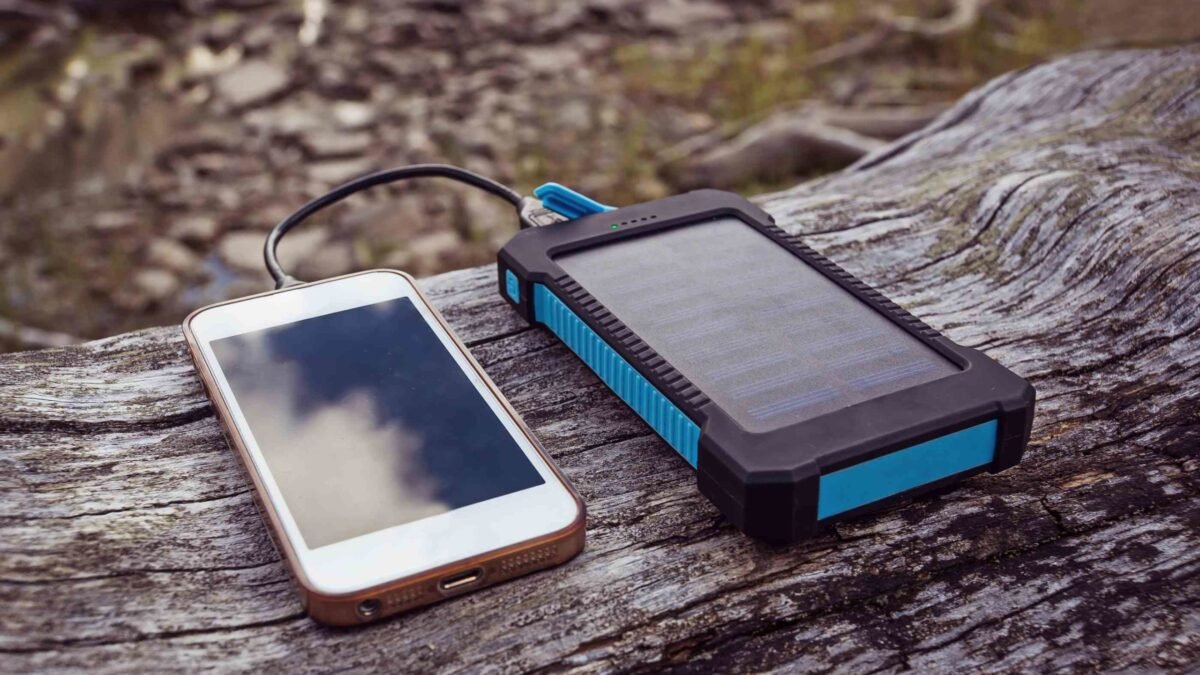
A solar power bank in Nigeria will usually need well over a week of strong sunshine to fill a 20,000mAh battery from its own panel, because the panel on a phone-sized power bank can only produce about 2 watts at its very best. That doesn’t make these power banks useless, but it does mean the panel is a backup trickle and not the main way you’ll charge it.
Solar power banks are everywhere in Nigerian markets and online shops, often sold with big capacity claims and pictures of the panel doing all the work. If you’re buying one for long power outages, a trip or a shop with no generator, it helps to know what the panel can really do, so you size it properly and charge it the right way. The checks below take a few minutes and can save you from paying for a feature you’ll hardly use.
Why a solar power bank panel charges so slowly
A genuine 20,000mAh power bank stores about 74 watt-hours of energy, which you get by multiplying 20,000mAh by the cell voltage of 3.7V and dividing by 1,000. Our guide on checking a power bank’s real capacity explains why that watt-hour figure matters more than the mAh number on the box.
The panel is the other half of the sum. Direct midday sun delivers roughly 1,000 watts of light per square metre, and good consumer solar cells turn about a fifth of that into electricity. A panel the size of a typical power bank face, around 15cm by 7.5cm, covers about 0.011 square metres, so even in perfect conditions it tops out at roughly 2.2 watts. Real conditions are rarely perfect, because the angle of the sun changes through the day, dust and clouds cut the light, heat lowers panel output and the charging circuit loses some energy on the way in.
If you assume a realistic 1 watt reaching the battery, 74 watt-hours works out to around 74 hours of strong sun. With five or so hours of usable sunshine on a good day, that’s about two weeks to fill the battery from empty. On a dusty harmattan day or during the rainy season, it’ll take longer. These are estimates, not lab results, but the maths is the same for every small panel, whatever the label says.
Leaving it in the sun can hurt the battery inside
Heat is a bigger worry than charging speed, because most lithium-ion cells are rated by their makers to charge only up to around 45°C, and a dark plastic power bank lying on a windowsill, car dashboard or shop table in direct Nigerian sun can get much hotter than the air around it. Charging a hot battery speeds up wear, and over months that shows up as a power bank that empties faster than it used to.
Don’t leave a solar power bank baking in a closed car, because the temperature inside can climb well past what any lithium battery is designed for. If the casing feels hot to the touch, move it into shade and let it cool before you charge your phone from it. Stop using any power bank that swells, bulges or smells of burning, because a damaged lithium battery can catch fire.
When a solar power bank is still worth buying in Nigeria
The panel works best as insurance for the times when light is off for days, when you’re travelling where there’s no socket, or when you run a stall where you can leave the power bank in light shade for most of the day. In those cases, a slow top-up adds a little charge you wouldn’t otherwise have. A few hours of sun won’t fill the battery, but it can add enough for some calls and WhatsApp messages in an emergency.
Pros
- Adds a small emergency top-up when there's no power for days
- Useful for travel, farm visits, outdoor work and long road trips
- Usually charges normally from a wall socket or generator like any power bank
Cons
- The small panel can take around two weeks of strong sun to fill a 20,000mAh battery
- Direct sun heats the battery and can shorten its life
- Large capacity claims on cheap models are often exaggerated
- The panel adds bulk and weight compared with a regular power bank of the same capacity
If what you really need is to keep a phone, router and small fan running through long outages, a power bank with a tiny built-in panel won’t do that job. A bigger battery paired with a proper folding solar panel of 20 watts or more is the better route, and our portable power station buying guide shows how to size one for your home.
Check these on a solar power bank before you pay
Many solar power banks sold in Nigeria are unbranded, so the label is all you have to go on. Read it carefully, and don’t be afraid to walk away from one that won’t tell you the basics.
Don’t buy a solar power bank for a flight without checking its watt-hour rating first, because airlines limit power banks by Wh and a big unbranded unit with no rating printed on it can be refused at the airport. Our guide to taking a power bank on a plane covers the limits. And when you do charge it from a socket, use a decent charger, since our explainer on phone chargers and fakes applies here too.
Buy it if
- People who travel or work outdoors and want an emergency top-up
- Anyone who already charges from a socket or generator and wants a little backup during long outages
- Buyers who'll keep it in light shade, not baking in direct sun
Skip it if
- Anyone expecting the panel to replace wall charging
- Households that need to run a router, fan or laptop through outages
- Buyers looking at unbranded units with no Wh or panel rating printed
Buy a solar power bank for its battery and its wall charging, and treat the panel as a slow emergency extra.
The practical aim is to judge a solar power bank the way you’d judge any power bank, by its real capacity, its charging speed and how honest its label is. If it passes those checks, the panel is a handy bonus for the days when the light doesn’t come back.


Join the conversation